

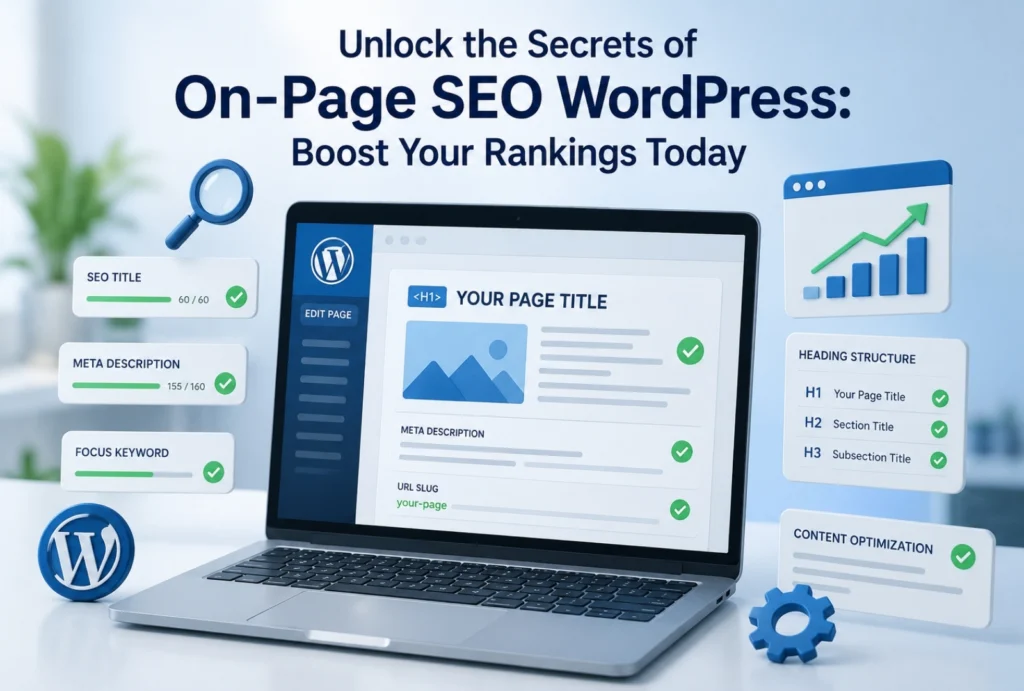
On-page SEO for WordPress means optimizing the elements directly on your site content, keywords, titles, headings, internal links, images, and speed so search engines understand your pages. Paired with off-page SEO, which builds authority through backlinks and mentions, it forms the two pillars of every ranking strategy.
Most “on-page SEO” guides either drown you in jargon or skip straight to a plugin recommendation. Both sides of the issue are covered in this guide: the on-page fundamentals every WordPress site needs, and the off-page activities that determine whether Google actually trusts your site enough to rank it in one place, with WordPress-specific steps you can act on today.
Key Takeaways
- On-Page SEO: encompasses everything directly on your WordPress site: content, keyword intent, technical architecture, schema markup, and Core Web Vitals.
- Off-Page SEO: builds external trust and authority via quality backlinks, digital PR, brand mentions, and social proof.
- Hybrid Search Landscape: Ranking requires optimizing for traditional search algorithms, Answer Engine Optimization (AEO), and Generative AI Overviews.
- Repeatable Execution: High rankings rely on systematic technical audits, structured data implementation, and continuous performance tuning.
What Is On-Page SEO? (What Is On-Site SEO)
On-page SEO (or on-site SEO) is the practice of optimizing internal elements across your WordPress website, including content quality, HTML tags, site architecture, internal linking, and load speed—to help search engines interpret topic relevance and satisfy user search intent.
Strong backlink authority alone cannot compensate for pages that poorly satisfy search intent, lack useful content, or make their topic and structure difficult for users and search engines to understand.
10 Core On-Page SEO Steps for WordPress
Search engines and AI bots favor logically organized, step-by-step procedures. Implement these on-site elements systematically:
- Target Search-Intent Keywords: Conduct keyword research to identify the primary target term, conversational long-tail queries, and semantically related subtopics.
- Optimize Title Tags: Write concise, descriptive titles that clearly communicate the page topic, naturally incorporate the primary search concept where appropriate, and give users a compelling reason to click.
- Write Useful Meta Descriptions: Create a unique, descriptive summary that accurately represents the page and gives searchers a compelling reason to click. Google may use the meta description or generate a different snippet from page content depending on the query.
- Establish Heading Hierarchy: Use a single H1 tag per page, followed by systematically nested H2 and H3 subheadings to organize subtopics.
- Configure Clean Permalinks: Set concise, keyword-focused URL structures in WordPress settings (e.g., /on-page-seo-wordpress/).
- Implement Contextual Internal Links: Connect topic clusters using descriptive anchor text to pass link equity and guide AI crawlers across your site.
- Optimize Media Assets: Compress images to modern formats (WebP), use descriptive file names, and include contextual alt text for accessibility and search indexing.
- Tune Core Web Vitals: Reduce plugin overhead, implement caching/CDNs, and select lightweight WordPress themes to improve Interaction to Next Paint (INP) and Largest Contentful Paint (LCP).
- Ensure Responsive Mobile Layouts: Validate responsive design across all viewports to adhere to mobile-first indexing standards.
- Implement Relevant Structured Data: Add structured data that accurately represents the page, such as Article and BreadcrumbList markup where applicable. Validate the markup and keep it consistent with the visible page content.
WordPress On-Page SEO Checklist
| Element | What to Check |
| Title Tag | Unique and descriptive; front-loaded with the primary keyword. |
| H1 | One clear primary page heading per page. |
| URL | Short, descriptive, keyword-focused permalink. |
| Search Intent | Content directly answers the target query within the first 60 words. |
| Internal Links | Descriptive anchor text pointing to relevant supporting/service pages. |
| Images | Compressed (WebP format), descriptive file names, and accessible alt-text. |
| Core Web Vitals | Passing scores for LCP, INP, and CLS. |
| Mobile UX | Responsive design and easy-to-navigate interface. |
| Structured Data | Relevant, valid schema (Article, FAQ) matching visible content. |
| Indexability | Correct canonicals, robots directives, and sitemap inclusion. |
Keyword Placement and Semantic Optimization
Modern search algorithms rely on natural language processing (NLP) and entity association rather than raw keyword repetition.
- Primary Placement: Include your primary search term naturally within the H1, the opening 50–100 words, and select subheadings.
- Semantic Entities: Incorporate secondary keywords, industry terms, and contextual synonyms across the body copy.
- Intent Depth: Prioritize complete topic coverage over arbitrary keyword density targets.
- Conversational Long-Tail: Include full question-and-answer phrasing to capture voice search and generative AI summaries.
What Is Off-Page SEO?
Off-page SEO refers to optimization efforts conducted outside your domain to boost your site’s authority, trust, and industry footprint. While on-page SEO clarifies what your page is about, off-page signals show search algorithms why your site deserves high-ranking placement.
Off-Page SEO Activities and Techniques
- Earning backlinks from relevant, reputable websites through guest posting, digital PR, and outreach
- Building brand mentions across industry publications and forums, even without a direct link.
- Maintaining active, engaged social media profiles that drive traffic and signal relevance.
- Managing accurate, consistent business listings and citations across directories
- Gathering and addressing client feedback on websites such as Google Business Profile
- Building genuine partnerships and collaborations that generate natural, editorial backlinks
On-Page vs. Off-Page SEO: Side-by-Side
| Factor | On-Page SEO | Off-Page SEO |
| Where it happens | Directly on your website and its pages. | External to your website. |
| What it controls | Content, keywords, structure, speed, UX. | Backlinks, brand mentions, social signals, PR. |
| Search Engine Signal | Relevance: What the page is about. | Authority: Why the page deserves to rank. |
| Level of control | Fully within your control. | Partial control (earned, not just built). |
| Typical Tools | SEO plugins, page speed tools, schema plugins. | Outreach tools, backlink trackers, PR platforms. |
| Time to see results | Faster (improvements are immediate upon indexing). | Slower (authority compounds over time). |
Optimizing WordPress Content for AI Search and AI Overviews
Google’s guidance for AI Overviews and AI Mode continues to emphasize core SEO fundamentals rather than a separate set of “AI SEO” requirements. For WordPress publishers, that means creating useful, original content, maintaining strong technical accessibility, making important information easy to find, and structuring pages so both users and search systems can understand them.
- Direct Answer Positioning: State the direct answer to the user’s primary query in the first 40–60 words beneath the heading.
- Query-Formatted Subheadings: Frame H2 and H3 headers as clear search queries (e.g., “How do you optimize images for WordPress SEO?”).
- Information Density: Use tables, ordered lists, and concise bullet points that Large Language Models can easily parse and cite.
- Structured Data Integration: Implement valid JSON-LD schema markup to establish clear entity relationships.
How Champ360Marketing Approaches On-Page and Off-Page SEO
Champ360Marketing’s Precision360 Marketing process treats on-page and off-page SEO as one connected system, not separate checklists. Every engagement starts with an in-depth site audit and competitor analysis, followed by strategic recommendations covering on-site optimization and off-site authority building, backed by proprietary AI-driven tools that track market and keyword trends specific to each client’s domain.
- Full on-page audits covering content, technical SEO, and WordPress-specific performance issues
- Off-page strategy including backlink outreach and digital PR
- Content optimization designed for both traditional search and AI-assisted search experiences
- Transparent reporting tied to real ranking and traffic outcomes, not vanity metrics
Ready to see where your WordPress site’s on-page and off-page SEO actually stand? Let’s talk with the Champ360Marketing team.
The Bottom Line
On-page and off-page SEO aren’t competing strategies; they’re two halves of the same ranking equation. Get your on-page SEO WordPress fundamentals right, then build the off-page authority to back it up, and you have a strategy built to hold up under both traditional search rankings and the AI-driven search landscape reshaping 2026. Champ360Marketing’s Precision360 process is built to execute both, together.
FAQs
What is on-page SEO?
On-page SEO, also called on-site SEO, is the practice of optimizing content and elements within your website, including title tags, headings, URLs, internal links, images, page experience, and structured data, to help search engines understand the page and help users find the information they need.
What is off-page SEO?
Actions made outside of your own website to increase its authority and credibility are referred to as off-page SEO. These actions mostly involve obtaining backlinks from other websites, brand mentions, social signals, and digital PR.
What are the main on-page SEO steps for a WordPress site?
The fundamental on-site SEO tasks for WordPress include researching keywords, improving meta descriptions and title tags, organizing content with appropriate headings, adding internal links, compressing and alt-tagging images, improving page speed, and ensuring mobile-friendliness.
What are common off-page SEO activities?
Common off-page SEO activities include earning backlinks through guest posting and digital PR, building brand mentions, engaging on social media, managing online reviews and business listings, and forming partnerships that generate natural links back to your site.
Does ranking well require both on-page and off-page SEO?
Yes. On-page SEO signals to Google what your page is about, while off-page SEO signals why your site can be trusted. Google’s ranking systems weigh both relevance and authority together, so strong pages with no backlinks or lots of backlinks pointing to weak pages both struggle to rank.
How is on-page SEO different in 2026 with AI search and AI Overviews?
On-page SEO now also has to account for how AI systems summarize and cite content, not just how traditional search rankings work. That means writing clear, direct answers early in the content, using structured headings, and adding FAQ and Article schema, so AI Overviews and other AI-generated answers can accurately extract and cite the page.