

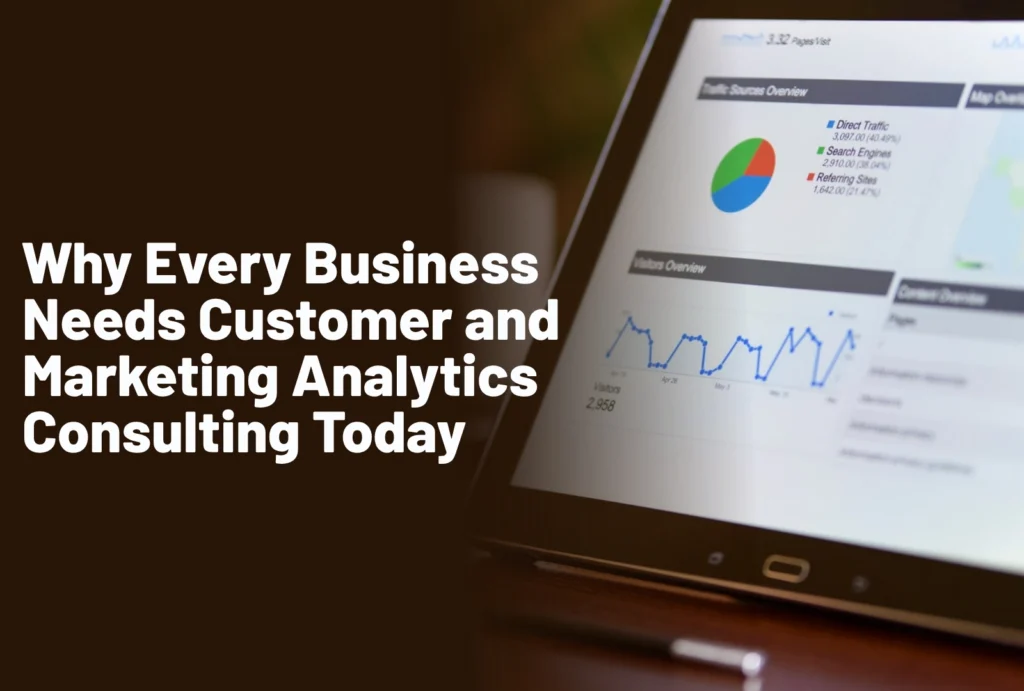
Customer and marketing analytics consulting helps businesses turn customer behavior, campaign performance, and channel data into evidence-based decisions about strategy, budget, targeting, and optimization. Instead of relying primarily on assumptions, businesses can use measured performance to understand what’s working, what isn’t, and where to invest next.
Most businesses can tell you what their marketing is doing. Far fewer can tell you why it’s working or why it isn’t. That gap is exactly what customer and marketing analytics consulting is meant to close, and it’s becoming less of a nice-to-have and more of a baseline requirement for staying competitive.
Here’s why analytics-driven consulting matters now more than ever, what it actually changes about how a business markets itself, and how businesses can use analytics to connect marketing activity to measurable outcomes.
Key Takeaways
- Customer and marketing analytics consulting replaces guesswork with evidence-based decisions about where to spend and what to change.
- Businesses without reliable measurement may continue funding underperforming channels simply because the right performance signals aren’t being tracked or interpreted correctly.
- A good digital marketing consultant audits performance first, then builds strategy, not the other way around.
- Most engagements follow a five-step process: data audits, measurement definition, channel analysis, strategic recommendations, and ongoing execution.
- Continuous monitoring helps businesses identify declining performance earlier instead of waiting for quarterly reports or long-term revenue impact to reveal a problem.
- Analytics-driven marketing helps allocate limited budgets more deliberately by identifying stronger and weaker-performing channels, campaigns, and customer segments.
What Is Customer and Marketing Analytics Consulting?
Customer and marketing analytics consulting is the process of analyzing customer behavior, campaign data, conversion performance, attribution, and marketing-channel metrics to improve business decisions. A consultant turns that data into recommendations about audience targeting, budget allocation, customer journeys, messaging, channel strategy, and performance optimization.
Unlike basic reporting, analytics consulting doesn’t stop at showing what happened. It aims to explain why performance changed, what the data suggests, and what the business should do next.
The Problem With Marketing on Instinct
Experience, competitor activity, vendor recommendations, and assumptions about the audience often influence marketing decisions. Without reliable measurement, it can be difficult to determine whether those assumptions are actually producing business results.
That’s the core problem customer and marketing analytics consulting solves. It replaces assumptions with evidence at every stage, from where budget gets allocated to which messaging actually resonates.
What Analytics Consulting Actually Reveals
A strong analytics engagement can help identify:
- Which channels are genuinely driving conversions, not just traffic.
- Where and why people stop buying.
- Which segments of the audience respond to which messaging.
- Where marketing spend may be wasted on low-performing tactics.
- Customer acquisition cost (CAC) per channel or campaign.
- Cost per lead (CPL) and lead-to-customer conversion rates.
- Return on ad spend (ROAS) and broader marketing ROI.
- Customer lifetime value (LTV or CLV) across key segments.
- Funnel abandonment points and conversion bottlenecks.
- Channel attribution patterns and assisted conversions.
- Customer retention, repeat purchase behavior, and churn.
- Campaign performance by audience, creative, offer, and device.
These aren’t abstract insights; they’re specific, actionable findings that a digital marketing consultant can turn directly into a revised strategy.
The goal isn’t simply to identify which channel produces the most clicks. It’s to understand which activities generate qualified leads, customers, repeat business, and profitable revenue.
How Customer and Marketing Analytics Consulting Works
Most analytics consulting engagements follow a process that moves from measurement to action:
1. Data Audit
Review analytics platforms, advertising accounts, CRM data, website tracking, conversion events, reporting systems, and data quality to identify gaps before concluding.
2. Measurement and KPI Definition
Define the metrics that matter to the business, which may include CAC, CPL, conversion rate, ROAS, revenue contribution, retention, customer lifetime value, and lead quality.
3. Customer and Channel Analysis
Analyze audience segments, customer journeys, acquisition sources, campaign performance, conversion behavior, and underperforming channels to identify meaningful patterns.
4. Strategic Recommendations
Translate findings into decisions about budget allocation, messaging, targeting, campaigns, content, landing pages, and channel priorities.
5. Execution and Monitoring
Implement recommendations, track the results, test changes, and continue refining the strategy as customer behavior and campaign performance evolve.
Why This Matters More Today Than Ever
Customer behavior shifts faster than it used to, and the number of channels businesses have to manage search, social, paid, email, content has multiplied. Without consistent analytics, it’s nearly impossible to know which of those channels are actually contributing to growth versus quietly draining budget.
Modern e-marketing solutions increasingly rely on AI-powered auditing and automation to keep pace with that complexity, making continuous and near-real-time performance analysis more accessible than the periodic reporting cycles many businesses traditionally relied on.
AI can also help surface anomalies, keyword shifts, campaign trends, and customer patterns faster. Still, human interpretation remains important for deciding whether those patterns are meaningful and what actions should follow.
Marketing on Guesswork vs. Analytics Consulting
| Approach | Marketing by Guesswork | Customer & Marketing Analytics Consulting |
| Decision basis | Gut feel, industry trends, competitor copying | Audited data, behavior patterns, verified performance |
| Budget allocation | Spread evenly or based on assumption | Prioritized toward channels with stronger measured performance and business impact |
| Reporting | Vanity metrics like impressions or likes | Metrics tied to conversions, retention, and revenue |
| Speed to correction | Problems surface months later | Regular monitoring can surface performance issues earlier |
| Customer understanding | Broad assumptions about the audience | Precise behavioral and segment-level insight |
Marketing Reporting vs. Marketing Analytics Consulting
| Area | Marketing Reporting | Analytics Consulting |
| Main question | What happened? | What should we do and why did it occur? |
| Primary output | Dashboards and reports | Recommendations and decisions |
| Focus | Metrics and trends | Business outcomes and strategic implications |
| Analysis | Descriptive | Diagnostic and strategic |
| Example | Organic traffic fell 15% | Why traffic fell, what likely caused it, and which actions may improve performance |
Reporting is necessary, but reporting alone doesn’t automatically create better decisions. Consulting adds interpretation, context, prioritization, and a plan for what should happen next.
When Does a Business Need Marketing Analytics Consulting?
Customer and marketing analytics consulting becomes especially valuable when:
- Marketing spend is increasing, but ROI is unclear.
- Different platforms report conflicting performance numbers.
- Lead volume appears healthy, but quality is low.
- Customer acquisition costs are rising.
- The company cannot clearly link marketing activities to income.
- Teams focus heavily on traffic, impressions, or clicks without understanding conversion impact.
- The number of acquisition channels has become difficult to manage.
- Manual reporting consumes significant internal time.
- The business has plenty of data but isn’t using it consistently to make decisions.
- Marketing teams disagree about which channels or campaigns deserve more budget.
How Champ360Marketing Approaches Analytics Consulting
Champ360Marketing was built specifically around the problem of guesswork-driven marketing. The agency’s Precision360 Marketing process starts with an in-depth audit and competitor analysis, followed by detailed insights and reporting, strategic recommendations, and continuous execution and performance monitoring, all powered by proprietary AI-driven tools that track market and keyword trends specific to each client’s domain.
- In-depth audits and competitor analysis before any strategy is proposed.
- Proprietary AI tools tracking market trends and keyword insights.
- Transparent, detailed reporting tied to measurable outcomes.
- Champ360Marketing currently reports 50+ completed projects and a 99% client retention rate.
The objective is not simply to generate more reports. Precision360 is designed to connect data analysis with decisions about positioning, channels, content, campaign performance, and ongoing optimization.
Ready to find out which parts of your marketing are driving results and which may be wasting budget? Talk with the Champ360Marketing team about a data-driven marketing assessment.
The Bottom Line
Every business is already generating data that can help it market more intelligently. The question is whether anyone is translating that information into practical decisions.
Customer and marketing analytics consulting makes that translation possible by connecting customer behavior, campaign performance, channel data, and business outcomes to a clearer, evidence-based path forward.
For businesses managing multiple channels or constrained budgets, better measurement doesn’t necessarily mean spending more. It can mean understanding where existing resources are producing value, where they are not, and what should change next.
Champ360Marketing’s Precision360 process is built to do exactly that.
FAQs
What does a digital marketing consultant do?
A digital marketing consultant audits a business’s current marketing performance, analyzes customer and channel data, and builds a data-backed strategy to improve results, rather than applying generic tactics without evidence they’ll work.
What is customer and marketing analytics consulting?
Customer and marketing analytics consulting is the process of analyzing customer behavior, campaign performance, attribution, conversion data, and channel metrics to guide marketing decisions. The goal is to identify what is influencing business outcomes and turn those findings into practical recommendations about budget, targeting, messaging, and channel strategy.
How is a digital marketing consultancy service different from hiring an agency?
A digital marketing consultancy service typically focuses on strategy, analysis, and recommendations, while a full agency may also handle execution. Many consultancies, including data-driven ones, combine both: audits and insights paired with hands-on implementation.
How often should a business review its marketing analytics?
The right cadence depends on the metric. Paid campaign performance may need daily or weekly review, while SEO, customer lifetime value, retention, and broader strategic performance are often more meaningful when evaluated over longer periods. The goal is continuous measurement without overreacting to short-term fluctuations.
Can small businesses benefit from marketing and digital solutions built on analytics?
Yes. Small businesses can benefit significantly because analytics-driven marketing and digital solutions help them allocate limited budgets toward channels, campaigns, and customer segments showing stronger measured performance instead of spreading resources evenly across untested tactics.
What should I look for in a marketing analytics consultant?
Look for a consultant who starts with measurement and data quality before recommending tactics, connects marketing metrics to business outcomes, explains findings clearly, and can translate analysis into practical changes across channels, budgets, targeting, and campaigns. Strong consultants should also be transparent about attribution limitations and data quality.
How much does marketing analytics consulting cost?
Costs vary based on the number of channels and data sources, the quality of existing tracking, reporting complexity, attribution requirements, and whether the engagement includes strategy and execution. A focused analytics audit typically requires less work than an ongoing consulting engagement involving continuous monitoring, testing, and optimization.