


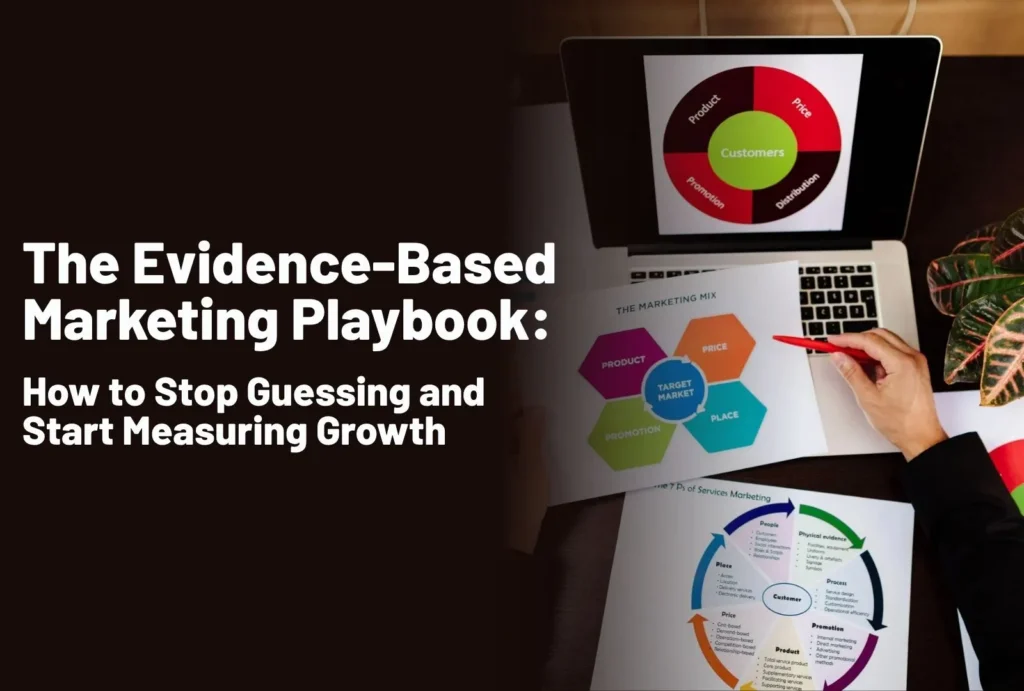
A marketing plan based on evidence gets rid of guesswork by following a consistent cycle: first audit the data you currently have, then develop specific hypotheses, decide which ones to pursue according to their possible impact, carry out small tests, and only after measuring the results should you scale up. By doing this, marketing ideas are turned into experiments that can be tracked rather than being treated as single shots, ensuring that every dollar spent gives you some insight into what in fact drives growth.
Nearly all marketing plans do not fail due to poor ideas; instead, they fail since it is impossible to state with any degree of confidence which of the ideas actually worked, as a result of which the same guesses are reused quarter after quarter, being presented in a new deck. When you want to create a marketing plan that doesn’t merely appear well-organized but one that actually works, the solution is not to increase creativity but to start with evidence rather than with ideas.
The playbook sets out a practical and repeatable approach to developing a marketing plan based on measurement from the very beginning, explaining how marketing ideas should be generated by moving away from brainstorming in isolation, how to select the appropriate strategy for your current stage of growth, and how to determine whether a campaign is actually working before having spent the entire budget to find out.
Key Takeaways
- A marketing plan based on evidence begins with an audit, not with brainstorming, since you can’t prioritize ideas until you have measured them.
- Across the industry about one quarter of marketing budgets are spent on activities which yield no measurable return, mainly due to the underuse of tools and unclear tracking, not because of poor ideas.
- The best marketing ideas arise from three different sources: filling gaps that have been identified in an audit, responding to questions that customers frequently ask, and improving content that is underperforming by producing a revised version, rather than relying on open-ended brainstorming.
- Strategy and plan are separate documents covering different time frames: the strategy gives the lasting ‘why’ and the plan provides the tactical ‘how’, with it being reviewed every quarter.
- Small, carefully controlled tests carried out before making large budget commitments mean that every campaign serves as evidence for the next one, whatever the outcome is.
Why Most Marketing Plans Fail Before They Start
The main idea behind most marketing plans is sensible in that one should look at what competitors are doing, take a few tactics that have worked in other situations, and then fill in a content calendar. The issue is that this method never produces evidence; it only produces activity. And activity that is not measured turns out to be expensive.
Independent research arrives at a figure similar to that of the marketers: they estimate that about a quarter of their budget is spent on channels or tactics which produce no measurable return. The main reason isn’t a lack of tools; most teams in fact make use of only about one third of the martech capabilities for which they have already paid. One further industry survey showed that most marketing leaders are still confident that their budgets are being well used, even though nearly half of them privately admit that part of their spending is not delivering full value, a gap that researchers have begun to refer to as a “confidence paradox”: the teams feel positively about their marketing because the dashboards are full, not because the dashboards are accurate.
It is precisely this gap between trust and evidence that an evidence-based plan is designed to eliminate. For a more detailed examination of why this occurs and of the associated costs, see Champ360’s previous analysis of
This playbook explains, at a strategic level, why analytics-based marketing usually outperforms guesswork; it then moves into the step-by-step mechanics of building the plan.
The 5-Step Framework for How to Devise a Marketing Plan
The central cycle consists of audit, hypothesize, prioritize, test, measure, and scale; it runs every quarter, and each iteration makes the next one more accurate because you rely on your own evidence rather than starting from scratch.
Step 1: Audit Before You Ideate
Before allocating any money to a new idea, record the current facts: traffic sources and their trend lines, which existing content or campaigns are converting, what return your last two to three quarters of spending yielded, and where your tracking has gaps. This audit forms the basis for evaluating all other decisions.
Step 2: Turn Gaps Into Hypotheses
Turn any gap the audit identifies into a testable hypothesis rather than accepting it as an assumption. For example, the statement ‘Our blog attracts traffic but brings about few conversions’ can be rephrased as ‘Adding a clearer mid-article call to action will increase the conversion rate by X%’. A hypothesis that includes a figure can be proven or disproven.
Step 3: Prioritize by Evidence, Not Enthusiasm
Arrange the hypotheses according to the ratio of expected impact to the effort and cost involved, and when your own historical data is limited, use any available data on past campaign performance, competitor benchmarks, or industry averages. Aim to support the ideas most likely to improve a key metric, not those that received the most enthusiasm during a meeting.
Step 4: Test Small Before You Commit the Full Budget
Carry out the most important ideas as limited tests—for example, by setting a cap on advertising spending, by using a restricted email audience, by testing just one version of the landing page—and establish a success criterion beforehand. That is what distinguishes a plan from a guess: you define what constitutes “working” before looking at the results, not after.
Step 5: Measure, Then Scale or Kill
For each test, evaluate it in terms of its threshold and then reach a clear conclusion as to whether to scale it, adjust it, or kill it. Put that conclusion back into the audit for the next quarter. After several cycles, you’ll develop a marketing plan that compounds instead of resetting to zero each quarter.
What Is the Real Origin of Marketing Ideas?
The request “We need more marketing ideas” is one of the most frequent things a marketing team hears, but it’s also one of the least helpful when it’s not based on data. Since open-ended brainstorming usually brings up whatever is currently at the top of people’s minds, such as a competitor’s latest campaign, a popular format, or an idea picked up at a conference, it doesn’t address what your particular audience or sales funnel actually requires.
The approach to generating ideas based on evidence reverses the usual method: rather than asking “what should we try”, it asks “what does the data show is broken or underused” and then lets the ideas emerge from that. In practice, this involves drawing on three areas: the gaps that have already been identified in your audit, the questions that your sales and support teams keep asking (since this kind of repeated questioning is a clear sign of unmet content or messaging needs), and your own underperforming assets — for example, a landing page, an ad set, or an old post that may need a more focused angle instead of being completely rewritten.
| Guesswork Idea Generation | Evidence-Based Idea Generation | |
| Starting point | Open brainstorm or competitor imitation | Audit findings and documented customer questions |
| Prioritization | Whoever argues loudest in the meeting | Ranked by expected impact and available evidence |
| Budget commitment | Full campaign spend up front | Small bounded test, then scale if it proves out |
| Success metric | Defined loosely, often after the fact | Set in advance, before the test runs |
| What a “failed” idea produces | A write-off and no reusable insight | Data that sharpens the next hypothesis |
Choosing the Right Marketing Strategy for Your Growth Stage
A marketing strategy and a marketing plan address different issues, and one of the most common reasons plans seem unfocused is that people mix them up. The strategy forms the permanent foundation it specifies the target audience, how you position yourself relative to competitors, and why a customer should choose you and it should remain unchanged for about a year. The plan, on the other hand, covers the tactical level beneath the strategy: it includes the channels to use, the campaigns to run, and the budget, all of which are reviewed and adjusted every quarter as new evidence becomes available.
The strategy that is adopted also relies very much on the company’s actual position. A business in its early stages generally requires a strategy involving quick and inexpensive testing of a number of channels, testing them only lightly in order to discover which one attracts attention before spending any real money. On the other hand, a company which already has a customer base is generally better off with a strategy aimed at strengthening what is already working, that is, improving attribution, refining segmentation, and scaling up the channels that have already been proven successful by the audit.
If you want more detail on what to watch for after campaigns launch, Champ360’s article on measuring ROI and demonstrating campaign performance lists the specific metrics to report. It explains how to avoid the trap of vanity metrics, which can weaken otherwise well-constructed plans.
Attribution deserves its own discussion, since it undermines more marketing strategies than poor creativity ever does. When you can’t properly link a conversion to the channel that caused it, all the prioritization decisions in this system are grounded in distorted evidence. It is worth reading Champ360’s explanation of why marketing attribution is flawed and what else you should measure before you set KPIs for a plan.
How Champ360 Marketing Applies This System: Precision360
Champ360 Marketing uses the same audit, hypothesis, test, and measure cycle in its Precision360 Marketing methodology. This well-structured, data-driven approach replaces guesswork with evidence at each stage of a client’s marketing plan.
- A thorough audit and competitor analysis — a detailed examination of a client’s existing website, campaigns, and competitive environment to identify strengths, weaknesses, and opportunities.
- A detailed examination and reporting — an audit report that clearly identifies the particular areas that should be given priority.
- Strategic recommendations — specific actions to be taken next which are directly based on the audit findings, not a general guide.
- Execution & Performance Monitoring — implementation paired with ongoing measurement, so tactics get refined in real time instead of running on autopilot for a full quarter.
Champ360 pairs this process with proprietary AI-powered tools to identify keyword and market patterns specific to a client’s domain, making evidence-based idea generation practical rather than theoretical; the ideas are already ranked by what audiences are actively searching for. Learn more about how Precision360 Marketing helps businesses grow smarter, or explore Champ360’s Analytics & Reporting services directly.
Want to stop guessing and start with a well-thought-out plan? Why not discuss a Precision360 audit with Champ360 Marketing?
The Bottom Line
You don’t need more marketing ideas; you need a process that helps you identify which ideas are worth funding before the budget is exhausted, not after. An evidence-based approach doesn’t eliminate creativity from marketing; it ensures creativity is directed at a real, quantifiable gap rather than a guess. Carry out the audit first, form hypotheses deliberately, test on a small scale, and let the evidence, not the most vocal person in the room, determine what to scale up.
FAQs
What is the actual meaning of ‘evidence-based marketing’?
It means every marketing decision which channel to fund, which idea to test, which message to run is backed by data from an audit, a past test, or a documented customer insight, rather than a hunch, a competitor’s move, or “what worked at my last company.” The plan can still be creative; the difference is that you test assumptions before you fund them.
How to devise a marketing plan if I have almost no historical data?
Start with a lightweight audit anyway: current traffic sources, on-hand customer feedback, and a competitor scan. Then treat your first quarter as a structured test: small budgets across two or three channels with clear success metrics so the plan generates its own data instead of waiting for data that doesn’t exist yet.
If marketing ideas aren’t obtained through brainstorming, where do they come from?
The strongest ideas usually come from three places: gaps your audit exposes, questions your sales and support team hears repeatedly, and underperforming content or campaigns worth a second version. Brainstorming still has a role, but it works best when it targets a specific, data-identified gap rather than a blank page.
What’s the difference between a marketing strategy and a marketing plan?
Strategy is the durable “why” and “who” of your positioning, target segments, and competitive angle reviewed maybe once or twice a year. A plan is the tactical execution of that strategy: specific campaigns, channels, budgets, and timelines, usually revisited quarterly as results come in.
How often should a marketing plan be reviewed?
Quarterly at minimum for the tactical plan, with a lighter monthly check-in on the metrics tied to each active test. The underlying strategy can stay fixed longer, but the plan itself should be treated as a living document that updates as evidence comes in.
How much does it cost to fix a marketing measurement problem?
It depends more on the scale of the martech stack than the size of the business; most of the cost is in cleaning up tracking and consolidating dashboards, not new software. A proper audit is the fastest way to scope the actual cost before committing to a fix.